Lesson Loft
Tools for Every Lesson
How I Turn Any Book Into a Complete Literature Study
A real-life look at the flexible reading routine we use to build discussion, deeper comprehension, written samples, story analysis, and creative projects around almost any book.

For a few years, we used an all-in-one language arts curriculum. We followed the schedule, answered the comprehension questions, did the grammar and vocabulary assignments, and then wrote the assigned paragraph or essay about the reading on most days. It was tidy. It was complete. And for a while, it worked well for us.
Until it didn’t.
What I eventually built instead was a flexible literature routine that works with almost any book we choose. It gives us structure without locking us into someone else’s book list, someone else’s pacing, or a constant stream of busywork. It also gives us plenty of room for discussion, written work samples, deeper analysis, and creative projects without making every reading day feel heavy.
This is the literature routine we use now, along with the reading resources I created to support it.
Why We Moved Away from an All-in-One Program
Our all-in-one language arts curriculum was great for a while. I liked having everything planned. I liked knowing the literature, comprehension, vocabulary, grammar, and writing pieces were all connected. But over time, I started to see the downside.
A typical day might include reading from our literature book, answering reading comprehension questions, doing a grammar or vocabulary assignment, and then completing a writing assignment based on the same reading.
It was a lot.
Not just a lot of work, but a lot of mental load. The reading itself was no longer just reading. It became the starting point for several different tasks, and by the time we got to the writing piece, my son was already tired of the book, tired of the questions, and tired of being asked to produce something from it. I noticed he was starting to hate writing, and I could see why.
The Aha Moment
Midway through that year, I bought a dedicated writing program and decided to stop using the writing assignments from our all-in-one curriculum. The change was immediate. Suddenly, writing was not the thing tacked onto the end of literature after his brain was already full. It had its own space, its own process, and it was fun all on its own.
And he loved it! He even started asking to do writing on his days off, which was not what I expected after watching him dread it for so long. That was the moment I realized the problem was not writing itself. The problem was how much reading, thinking, grammar, vocabulary, and writing we were asking him to manage at one time.
So the following year, I knew we would keep writing separate. I started looking for a literature curriculum to use alongside it but nothing quite fit. Some programs included books we had already read. Some used books we were not interested in. Some were not where I wanted us to be reading-level-wise. Some included too much writing, too much busywork, or samples that made me unsure whether I trusted the quality of the materials.
I looked at unit studies for specific books too, but I ran into many of the same issues: too much extra work, not enough depth where I wanted it, or no unit study at all for the books I actually wanted us to read.
What I really wanted was simple: I wanted to choose our own books. Books that fit my son’s reading level. Books that sometimes connected beautifully to our social studies or science units. Books that stretched him. Books that delighted him. Books we could change if something was not working.
At the same time, I did not want to give up the benefits of a real literature program. So instead of trying to find another curriculum that almost fit, I looked closely at what I actually wanted literature to do for us. Then I took the whole thing down to the studs and built it back up from scratch.
What I Wanted Our Literature Program to Do
I did not want a pile of worksheets for every chapter. I did not want to turn every chapter into a writing assignment. And I did not want to spend my weekends trying to reinvent a curriculum for each new novel.
What I wanted was a thorough reading comprehension routine that could work with almost any book. I wanted a familiar process we could repeat often enough that it became a habit. I wanted discussion, written options for independent work and work samples, occasional deeper analysis, a strong end-of-book wrap-up, and room for creative projects.
Most of all, I wanted something reusable without compromising on quality. Not a loose collection of activities, and not a curriculum locked to one book list, but a real literature program we could come back to again and again. What we ended up with is a five-part literature routine:
- Choose any book.
- Discuss after each reading session.
- Add occasional deep-dive work when the book calls for it.
- Map the story after you finish.
- End with a meaningful book project.
It gives us a complete, high-quality literature program we can bring to any book, without having to rebuild the curriculum every time we start something new.
Step One: Choose Any Book
Instead of starting with a fixed curriculum book list, we start with the book we actually want to read.
Sometimes we pick a book because it connects to something we are studying elsewhere. Sometimes I choose one because it is at just the right reading level. Sometimes we choose one because it is funny, beautiful, adventurous, emotional, or a can't-miss classic. If we just finished a heavy book I will choose something lighter. If we are on a poetry kick we can keep going with it.
The point is that the book is not limited by the curriculum. The curriculum comes with us. That means we can go higher or lower in reading level, move faster or slower, swap a book if needed, or follow an interest when it appears. I will share our fourth grade reading choices separately, but the beauty of this approach is that you can apply it to so many different novels, read-alouds, literature selections, and family book choices.
Step Two: Discuss After Each Reading Session
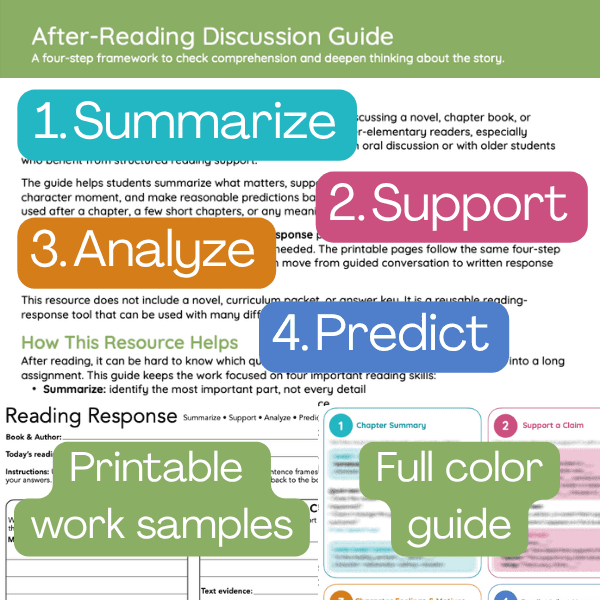
This is the part I think of as the secret sauce. After each reading session — whether that is a chapter, a few short chapters, a meaningful section, or a set amount of reading time — we use my After-Reading Discussion Guide.

The guide walks us through four key comprehension activities:
- summarizing what happened
- making a claim and supporting it with evidence
- thinking through character feelings, actions, and motives
- making reasonable predictions based on clues from the text
Most days, we do this out loud. If we are reading outside, I just pull the guide up on my phone and follow the prompts. I use the sentence starters and hints when we need them, and skip them when we don't. The structure is always there, and it doesn't feel like a test.
Over time, the repetition has been one of the most powerful parts. Because we use the same routine after each reading chunk, my son started to internalize the questions. Pretty quickly, he began calling out answers while we were still reading.
And that is the goal, right?
Not just answering comprehension questions after the fact, but building the habit of thinking while reading. Noticing what changed. Tracking what a character wants. Seeing what details matter. Holding onto a prediction and revising it as new information appears.
The After-Reading Discussion Guide also includes a worksheet version that matches the discussion sections. That gives us an easy written option when he is ready for more independence, when I need a work sample, or when I want him to practice putting his thinking on paper using the same tools he already knows.
Step Three: Add Occasional Deep Dives
The daily discussion guide keeps our reading work steady and consistent, and the deep dives give us a way to zoom in on one specific part of the book when we want to spend more time there. Maybe that means looking more closely at a character’s motivation, the role of the setting, the main conflict, a possible theme, how a character is changing, or what the author seems to be building toward.
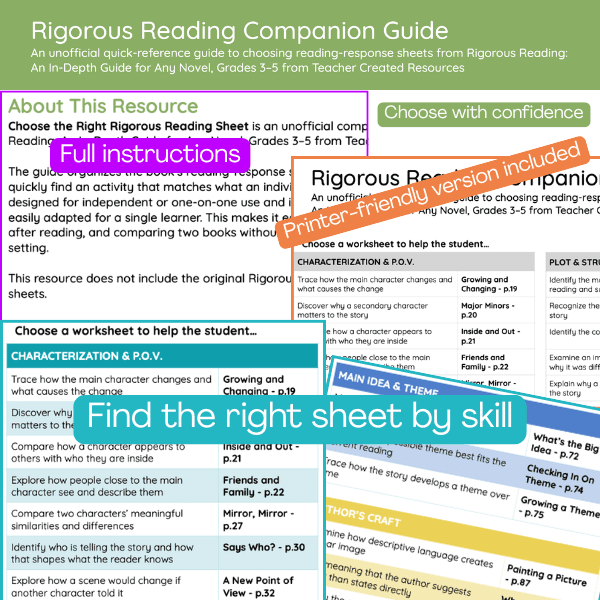
For that kind of work, I use Rigorous Reading: An In-Depth Guide for Any Novel, Grades 3–5 from Teacher Created Resources. It has worksheets for all kinds of literature skills, including pages for before you start a book, during the book, and after you finish. It is a great resource, but I found myself getting overwhelmed by the number of options. I did not always want to flip through the book trying to decide which worksheet matched what we needed that week.
So I created a companion resource to make that easier. My Rigorous Reading Companion Guide helps you choose which worksheet to use based on what you are trying to support. Instead of starting with a page number, you can start with the need: Do we need to understand a character better? Sort out the conflict? Compare ideas? Think about theme? Prepare before starting the book?

This is not something we use every day. For us, it works best every week or two, or whenever the book gives us something worth pausing over. It is also a helpful source of independent work and written work samples because it lets us go deeper without making every reading session worksheet-heavy.
Step Four: Map the Story After You Finish
When we finish a book, I like to pull back and look at the whole story. What was the main conflict? Which events really mattered? Where did the story turn? What was the climax? How did the ending resolve the problem? What theme or big idea can we take from the book?
I wanted a Plot Mountain resource that would guide students through the whole arc of the book in a way that was thorough, visually engaging, and supportive enough to use without staring at a blank page. I couldn’t find exactly what I wanted, so I made one.
My Plot Mountain Reading Response Worksheet helps students organize the major parts of a story, including the exposition, rising action, climax, falling action, resolution, conflict, important details, and theme. It includes sentence starters and gentle nudges so the work feels guided without giving the thinking away.

This has become one of my favorite end-of-book activities because it touches so many major parts of reading comprehension without making the work feel overwhelming. My son gets a lot out of sorting the rising action events, figuring out which problem was truly the main conflict, and debating where the climax actually happened. By the time we get to theme, we have the whole story in front of us, which makes that bigger conversation feel much more reachable.
It also makes a strong work sample because it shows comprehension, analysis, sequencing, and written explanation all in one place.
Step Five: End with a Meaningful Project
The final piece is a project. This part is intentionally more flexible. Over time, I plan to gather our favorite book project ideas in one place, but for now we choose from options like:
- writing a book review
- creating a book report
- making a poster for the book
- designing a brochure for the setting
- interviewing a character
- writing a journal entry from a character’s point of view
- turning part of the story into a comic strip
- acting out a scene
- explaining how and why a character changed
This is where we can connect writing back to literature without making writing an overwhelming daily requirement. Separating writing from literature helped us so much. But I still want my son to practice writing about books. I just want that writing to feel purposeful, manageable, and connected to something he has had time to think about deeply. A final project gives us that opportunity.
Why This Works for Us
When we put these pieces together, we have a literature program that feels rich, consistent, and flexible. We can choose almost any book we want. We can change books when needed. We can adjust the reading level. We can go quickly through an easier book or slow down with a more complex one. We can have deep conversations without turning every chapter into a packet.
Some parts stay the same every day, which builds confidence and habit. Other parts are guided by the book itself, which keeps the experience alive. That balance has been the biggest win for us: routine and flexibility, structure and choice, discussion and written work, reading comprehension and creativity.
This is our literature curriculum now: a flexible, repeatable program built around the books we actually want to read. And if you are trying to build something similar for your own homeschool, classroom, tutoring sessions, or family reading time, you can use the same basic routine:
- Choose a book.
- Discuss regularly.
- Go deeper when it matters.
- Wrap up the whole story.
- End with a meaningful project.
That is the whole framework. These are the resources I built to make it doable, repeatable, and strong enough to use all year.